Autocare
Tesla Window Tint Guide: Best Tint Percentages for Model 3 & Model Y
Find the best tint percentage for your Tesla Model 3 or Model Y.
Choosing the right Tesla window tint percentage isn’t simply a matter of picking the darkest shade you can find. For a Model 3 or Model Y, the best tint depends on which glass you’re tinting, how dark the factory glass already is, how much privacy you want, how often you drive at night, and whether heat rejection or appearance is your top priority.
For many Tesla owners, 35% ceramic tint is a strong starting point for rear glass when the goal is to balance privacy, appearance, and nighttime visibility.
Owners who want more privacy may prefer 20%, while 50% or 70% can make more sense when maintaining a brighter cabin and excellent visibility is more important.
Tesla’s large glass areas also make film performance important. The company currently offers professionally installed XPEL window tint. It describes its ceramic-particle technology as providing heat rejection, UV protection, glare reduction and a factory-style appearance without relying solely on darker tint.
This guide breaks down 20%, 35%, 50%, 70% and 5% tint, explains where each shade makes sense on a Tesla Model 3 or Model Y, and shows why the percentage printed on the film does not necessarily equal the final VLT of the completed window.
Quick Answer: What Tint Percentage Is Best for a Tesla?
There isn’t one tint percentage that is ideal for every Tesla. A practical starting point is:
Tesla glass | Starting point | Best for |
Front side windows | Very light ceramic, where legally permitted | Visibility, heat rejection |
Rear side windows | 20–35% | Privacy and appearance |
Rear glass | 20–35% | Privacy and a darker look |
Glass roof | 50–70% ceramic | Heat reduction without making the cabin feel dark |
Windshield | Very light/clear film where legally permitted | Heat and glare reduction |
Choose 20% if privacy and a darker appearance are your priorities.
Choose 35% if you want the best balance between privacy, appearance and visibility.
Choose 50% if you prefer a lighter cabin and frequently drive at night.
Choose 70% if your priority is heat and UV protection with minimal visual change.
These are starting points, not guarantees of legal compliance or final VLT. Tesla glass can vary by vehicle, model year, and glass location, so the existing glass should be evaluated before installation.
Tesla Window Tint Percentages Explained: What Does 20%, 35%, 50% or 70% Mean?
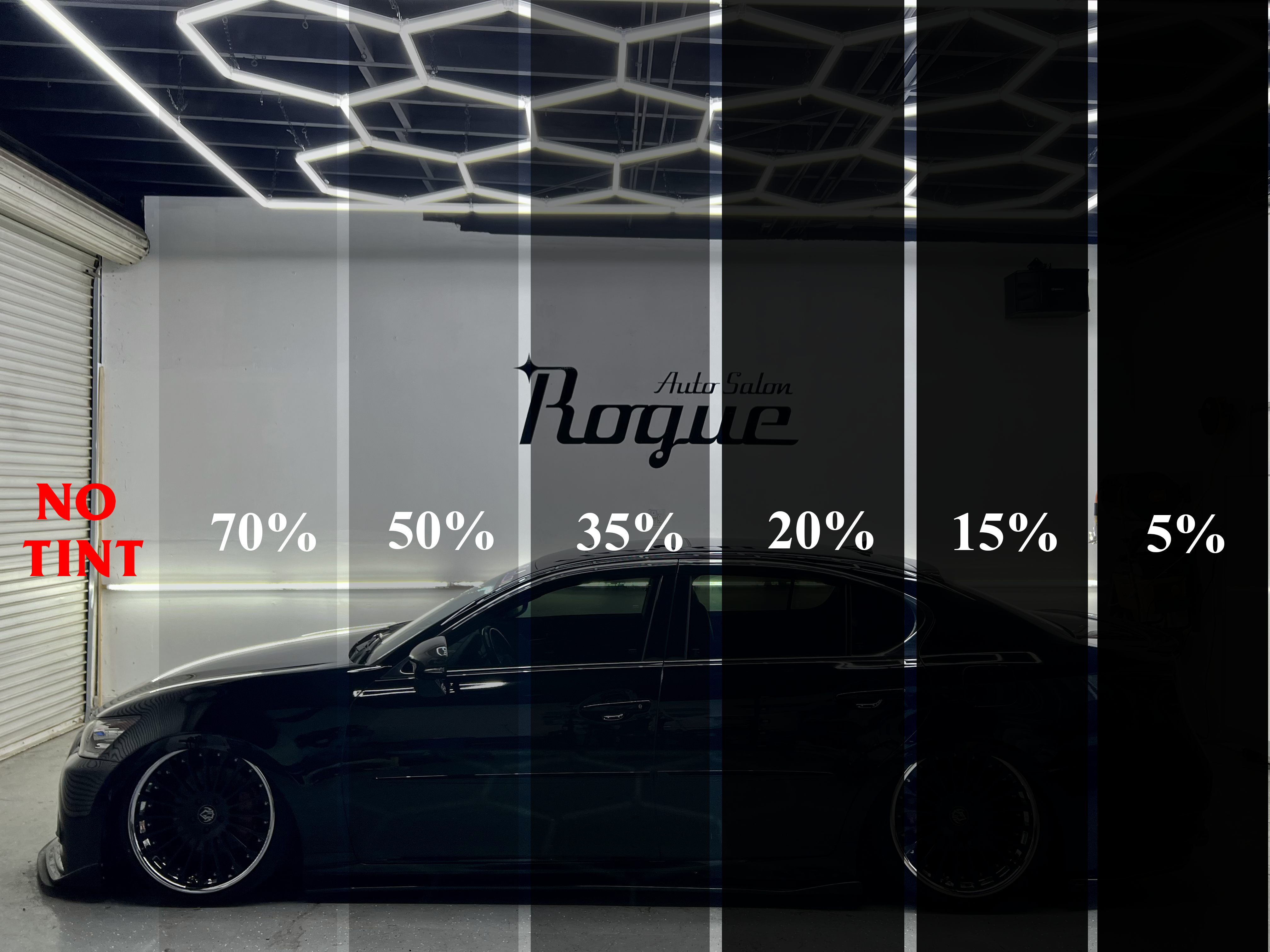
Window tint percentage refers to Visible Light Transmission (VLT), the amount of visible light that passes through the glazing.
The lower the VLT percentage, the darker the film appears:
- 70% VLT: Very light
- 50% VLT: Light
- 35% VLT: Medium
- 20% VLT: Dark
- 5% VLT: Extremely dark
However, the film percentage is not necessarily the final VLT of the Tesla window.
If aftermarket film is installed over existing glass, both layers affect the amount of light passing through the finished glazing. As a simplified example, 35% film over glass measuring 80% VLT would produce an estimated combined transmission of:
0.35 × 0.80 = 0.28, or approximately 28%
Actual finished-glazing measurements can vary, so an installer should measure the vehicle rather than relying solely on the film label or a mathematical estimate.
This is particularly important on Tesla models with factory privacy glass.
Does Darker Tesla Tint Reject More Heat?
Not necessarily.
Tint darkness and heat rejection are two different characteristics.
A 20% film is darker than a 70% film, but that does not automatically mean it rejects more solar energy. Film construction, infrared performance, total solar energy rejected, glass type, and the specific product line all affect thermal performance.
This is one reason ceramic film can be attractive for Tesla owners. Tesla’s current XPEL offering specifically describes ceramic-particle technology as a way to provide heat rejection without relying on dark tint.
If heat is your primary concern, compare the manufacturer’s performance specifications rather than choosing the darkest VLT available.
In other words:
Darker = less visible light.
It does not automatically mean:
Darker = cooler.
35% Tesla Window Tint: The Best Balance for Many Owners
If you want a noticeable tint without making the Tesla excessively dark, 35% is one of the strongest starting points to consider for appropriate rear glass.
It provides a darker appearance and more privacy than 50%, while allowing substantially more light through than 20% or 5%.
35% makes sense if you:
- Drive during both daytime and nighttime
- Want moderate privacy
- Prefer a darker exterior appearance
- Frequently park in garages or shaded areas
- Want to reduce glare without making the cabin extremely dark
- Don’t want the “blacked-out” appearance of 5% or very dark 20% film
The main advantage
35% sits in the middle of the privacy-versus-visibility tradeoff.
The main drawback
It may not provide enough privacy for owners who specifically want to minimize visibility into the rear cabin.
Best for: Tesla owners who want a balanced daily-driving setup rather than maximum darkness.
20% Tesla Window Tint: Darker Privacy Without Going to 5%
20% is a popular choice for Tesla owners who want a noticeably darker appearance and stronger privacy.
It can work especially well on appropriate rear glass when privacy is more important than maximum nighttime visibility.
Choose 20% if you:
- Prioritize privacy
- Want a dark exterior appearance
- Spend most of your driving time during daylight
- Prefer a more aggressive appearance
- Don’t mind reduced visibility compared with 35% or 50%
The tradeoff
20% allows significantly less light through the glass than 35% or 50%. That difference can become noticeable when reversing, parking at night or driving through poorly lit areas.
And on Tesla vehicles that already have dark factory glass, adding 20% film can produce a much darker final result than the same film would on clear glass.
Best for: Privacy-focused Tesla owners who are comfortable sacrificing some low-light visibility.
50% Tesla Window Tint: A Subtle, Comfortable Option
50% ceramic tint is a strong option for Tesla owners who want the benefits of film without dramatically changing the vehicle’s appearance.
It allows substantially more visible light through than 20% or 35%, making it attractive to drivers who frequently drive at night or simply prefer a brighter cabin.
50% makes sense if you:
- Drive frequently at night
- Want a subtle factory-style appearance
- Prefer excellent outward visibility
- Want heat and UV protection without darkening the cabin significantly
- Have a light-colored interior
- Don’t need maximum privacy
The key advantage is that you can prioritize thermal performance without using a very dark shade.
Best for: Tesla owners who care more about comfort, clarity, and heat reduction than privacy.
70% Tesla Window Tint: Light Film for Heat and UV Protection
70% film allows a large amount of visible light through the glass, so the visual change is relatively subtle.
That makes light ceramic film attractive when you want thermal protection without creating a noticeably dark cabin.
70% can make sense when:
- Visibility is a priority
- You drive frequently at night
- You want a near-factory appearance
- You want heat reduction without substantially darkening the glass
- You’re considering a large glass roof
- You want to minimize the visual change from the outside
Don’t confuse VLT with heat-rejection performance, however. A 70% film is not automatically better or worse at rejecting heat than a darker film. Compare the specific product’s published performance data.
For windshield and front-side applications, California owners also need to consider the legal requirements that apply to the completed glazing, not simply the film’s advertised VLT.
5% Tesla Window Tint: Maximum Darkness and Privacy
5% tint, often called “limo tint,” is extremely dark.
It provides the highest level of privacy among the shades discussed in this guide, but it also allows very little visible light through the film.
For a Tesla, that means the tradeoff can be especially noticeable when looking through rear glass at night, reversing in dark areas, or parking in garages.
5% makes sense only if:
- Maximum privacy is the priority
- You understand the visibility tradeoff
- The specific glass location and local laws permit the installation
- You are comfortable with an extremely dark appearance
For most daily-driven Teslas, I would not position 5% as the default recommendation.
Best for: Owners prioritizing maximum privacy and darkness over visibility and a lighter factory-style appearance.
Best Window Tint Percentages for Tesla Model Y
The Model Y’s large glass surfaces make tint selection especially important. The rear side glass, rear glass, and panoramic roof can all contribute to cabin heat, while the factory glass can also affect how dark an aftermarket film appears.
Recommended starting points
Model Y glass | Starting VLT range | Primary goal |
Front side windows | Very light film where permitted | Visibility + heat rejection |
Rear side windows | 20–35% | Privacy + appearance |
Rear glass | 20–35% | Appearance + privacy |
Glass roof | 50–70% ceramic | Heat reduction + open cabin |
Windshield | Very light/clear where permitted | Heat + glare reduction |
The most important Model Y consideration: factory glass
Before selecting 20% or 35% rear film, look at the existing glass.
A film that looks moderate on a clear sample can become dramatically darker when installed over already-dark factory glass.
For this reason, the best Model Y tint consultation should involve showing actual film samples against the vehicle rather than choosing solely from an online percentage chart.
Model Y Front Side Windows
For California owners, don’t simply choose 20%, 35%, 50%, or even 70% based on the film label.
California law has specific requirements for material applied to vehicle windows. Under Vehicle Code §26708, certain clear, colorless, transparent materials are permitted when they meet specified VLT, glazing, certification, and other requirements.
The statute includes a minimum 88% VLT for the material itself and requires the finished glazing system to meet applicable federal requirements, including a 70% minimum light-transmittance standard.
In other words, 70% film should not automatically be advertised as guaranteed legal simply because the film is labeled 70%.
Model Y Rear Side Windows
For rear side windows, 20–35% ceramic is a strong starting range.
Choose:
- 20% for stronger privacy
- 35% for balanced privacy and visibility
- 50% if you want a lighter appearance and better nighttime visibility
Model Y factory privacy glass already appears dark, so adding a very dark film may make the finished glass substantially darker than expected.
Model Y Rear Glass
The rear glass can also benefit from ceramic film, particularly when the objective is heat rejection rather than simply making the vehicle darker.
A 20–35% ceramic film can create a consistent appearance, while a lighter ceramic film can be used when visibility and thermal performance are more important than privacy.
Because the Model Y rear glass has significant curvature, installation quality matters. Poor shrinking or fitting can lead to distortion, fingers, creases, or visible imperfections.
Model Y Glass Roof: Should You Use Dark or Light Tint?
The Model Y’s large glass roof makes thermal performance an important consideration.
For most owners, the goal should be reducing solar heat without making the cabin feel unnecessarily dark.
That makes light-to-medium ceramic film worth considering.
A lighter film can maintain the open feeling of the panoramic roof while adding solar and UV protection. A darker film can change the appearance more dramatically but may not provide a proportional increase in thermal performance.
When choosing roof film, prioritize:
- Total solar energy rejection
- Infrared performance
- UV protection
- Optical clarity
- Glare reduction
- Interior brightness
- Film compatibility with the roof glass
Tesla also currently offers XPEL window tint and describes its ceramic-particle technology as providing heat rejection without relying on dark tint.
Best Window Tint Percentages for Tesla Model 3
The Model 3 has its own tinting considerations because of its large rear glass area and the way the glass interacts with the vehicle’s interior.
Model 3 front side windows
If visibility and compliance are priorities, start with a very light ceramic film where permitted. The final glazing should be evaluated rather than choosing a film based solely on its advertised VLT.
Model 3 rear side windows
For most owners:
- 20%: Strong privacy and darker appearance
- 35%: Balanced privacy and visibility
- 50%: Subtle appearance and stronger nighttime visibility
Model 3 rear glass
The best choice depends on whether your priority is appearance or thermal performance.
If you want the rear glass to look significantly darker, 20–35% may be appropriate where permitted.
If your main goal is reducing heat without making the large rear glass substantially darker, consider a lighter high-performance ceramic film.
Model 3 owner tip
Because the rear glass is large, don’t judge the final appearance from a small tint sample. Ask to see the film against the actual vehicle and, ideally, view it from both inside and outside.
Not sure between 20%, 35%, 50%, and 70%?
Rogue Auto Salon can help you compare film shades on your Tesla and choose based on privacy, visibility, heat rejection, and the vehicle’s existing glass.
Explore Tesla Window Tint Options
Tesla Factory Privacy Glass vs. Aftermarket Ceramic Tint
One of the most important things to understand before tinting a Tesla is that factory privacy glass and aftermarket window film are not the same thing.
Factory privacy glass changes the visible appearance and light transmission of the glass. Aftermarket ceramic film can add additional performance characteristics such as solar and infrared rejection, UV protection, and glare reduction.
That means a Tesla can benefit from aftermarket ceramic film even when the rear glass already looks dark.
Why this matters for Model 3 and Model Y owners
If the vehicle already has dark factory glass, adding 20% or 35% film does not mean the finished glass will simply “look like 20%” or “look like 35%.”
The existing glass and the film work together.
That’s why the correct process is:
Measure the existing glass → choose the film → evaluate the finished configuration.
Don’t choose based on the film percentage alone.
Why Ceramic Tint Is a Strong Choice for Tesla Owners
Tesla owners often care about heat rejection and cabin comfort without wanting extremely dark glass. That’s where high-performance ceramic film can be particularly useful.
A quality ceramic film can offer:
- Solar heat reduction
- Infrared rejection, depending on the product
- UV protection
- Glare reduction
- Optical clarity
- A darker appearance without relying solely on very dark VLT
Tesla currently offers XPEL window tint through its marketplace and describes the product as using ceramic-particle technology for heat rejection, along with UV protection, clarity, and glare reduction. Tesla also notes that installation is performed by XPEL-certified installers.
The important distinction is that ceramic describes the film technology, not the tint percentage.
You can have a light ceramic film or a dark ceramic film.
So when comparing products, evaluate both:
VLT + actual film performance.
Don’t assume that a darker ceramic film automatically performs better than a lighter one.

Can Window Tint Interfere With Tesla Electronics or Sensors?
High-quality non-metalized ceramic films are commonly chosen for modern vehicles because they do not rely on a metallic layer for their performance.
However, tinting a Tesla is still an installation job that requires attention to the vehicle’s cameras, sensors, antennas, and other technology.
The important issue is not simply whether “Tesla and tint are compatible.” It is whether the specific film and installation are appropriate for the specific glass location.
Tesla currently sells professionally installed XPEL window tint and describes its ceramic-particle technology as part of the product’s design.
A qualified installer should:
- Identify areas that should not receive film
- Avoid obstructing camera/sensor fields of view
- Use a film appropriate for the vehicle
- Inspect the finished installation for optical distortion
- Follow the film manufacturer’s installation requirements
Avoid making blanket claims that any tint product is guaranteed to not affect every Tesla system.
California Tesla Window Tint Laws: What Owners Should Know
California law is particularly important for Tesla owners considering darker front-window tint.
Vehicle Code §26708 generally restricts material that obstructs or reduces the driver’s clear view, while providing specific exceptions for areas such as side windows behind the driver and rear windows when the vehicle has appropriately positioned outside mirrors.
For qualifying clear, colorless, transparent materials, the law specifies requirements involving the film’s VLT, the finished glazing, UV-blocking characteristics, and certification.
The windshield also has separate rules, so a full windshield tint should never be assumed to be California-legal simply because it is marketed as “70%” or “clear.”
Before installation, ask the tint shop to:
- Measure your Tesla’s factory glass.
- Calculate the expected final VLT.
- Confirm the film’s certification.
- Explain which windows the selected film can legally be installed on.
- Verify the finished installation when appropriate.
Laws can change, and individual circumstances matter, so this guide should not replace current legal advice or verification with the applicable California authorities.
Tesla Tint Percentage Comparison
Tesla Tint Percentage Comparison
VLT | Appearance | Privacy | Night Visibility | Best For |
70% | Very light | Low | Excellent | Heat/UV protection with minimal visual change |
50% | Light | Mild | Very good | Comfort + subtle appearance |
35% | Medium | Moderate | Good | Balanced privacy and visibility |
20% | Dark | High | Reduced | Privacy-focused rear glass |
5% | Extremely dark | Very high | Limited | Maximum darkness where permitted |
Important: VLT describes visible-light transmission, not overall heat rejection. A darker film is not automatically a higher-performing film. When heat reduction is the goal, compare the specific film’s thermal performance data as well as its VLT.
Which Tesla Tint Percentage Should You Choose?
Your priority | Starting point |
Maximum privacy | 20% or darker where permitted |
Best balance | 35% |
Better nighttime visibility | 50% |
Minimal visual change | 70% |
Roof heat reduction | 50–70% ceramic |
Dark rear appearance | 20–35% |
Heat rejection without dark glass | Light ceramic |
Factory-style appearance | 50–70% |
These are starting points rather than universal recommendations. The existing Tesla glass, model year, glass location, and local requirements can change the appropriate choice.
Does Tesla Interior Color Affect Tint Choice?
It can affect how the tint looks from inside and outside.
A white or light-colored Tesla interior can make a given tint appear visually lighter than the same film on a dark interior. If you’re trying to achieve a specific exterior appearance, don’t judge the shade using an online photo of a Tesla with a different interior.
How Does Tesla Tint Affect Night Driving?
The darker the VLT, the less visible light reaches your eyes through the glass.
That’s most noticeable when driving through:
- Unlit roads
- Parking garages
- Poorly lit neighborhoods
- Rain
- Fog
- Dark parking lots
For drivers who spend significant time driving after dark, 35% or 50% may be a more comfortable choice than 20% or 5%.
The right choice also depends on which glass is being tinted. A very dark rear side window may be manageable for one driver but uncomfortable for another when reversing or checking blind spots.
If you’re unsure, compare the film from inside the vehicle at night or in a controlled low-light environment, not just outside during bright daylight.
What a Professional Tesla Tint Installer Checks Before Installation
A good Tesla tint consultation should involve more than asking, “What percentage do you want?”
An installer should consider:
- The exact Tesla model
- Model year and glass configuration
- Factory glass and existing VLT
- Which windows are being tinted
- Interior color
- Desired exterior appearance
- Nighttime driving habits
- Privacy requirements
- Heat-rejection goals
- Applicable local requirements
The installer should then show you actual film samples against the vehicle whenever possible.
The Most Important Step: Compare Tint on Your Actual Tesla
Online photos can give you an idea of what 20%, 35%, 50% or 70% looks like, but they cannot tell you exactly how that film will look on your Tesla.
Factory glass, interior color, lighting, and camera exposure can all change the appearance.
Before choosing a percentage, compare actual film samples against your vehicle and, where appropriate, measure the existing glass.
A professional installer can help you determine:
- Which percentage fits your privacy preference
- How dark the finished glass is likely to look
- Whether factory privacy glass will affect the result
- Which film is best suited to your heat-rejection goals
- Which configuration is appropriate for each glass location
- What documentation applies to the installation
Want to See the Difference in Person?
Bring your Model 3 or Model Y to Rogue Auto Salon and compare available film shades against your actual vehicle before making the final decision.
Tesla Window Tint FAQs
What is the best tint percentage for a Tesla Model 3?
For many owners, 35% is a strong starting point for rear glass when balancing privacy, appearance, and visibility. Drivers who want more privacy may prefer 20%, while 50% or 70% can be better for owners prioritizing visibility and a lighter appearance.
What is the best tint percentage for a Tesla Model Y?
A common starting range is 20–35% for rear glass and a lighter ceramic film for the front windows and glass roof when appropriate. The ideal choice depends on the factory glass, desired privacy, nighttime driving, and local requirements.
Is 20% tint too dark for a Tesla?
20% is relatively dark. It can provide strong privacy but reduces the amount of visible light entering the vehicle. Whether it feels too dark depends on the glass location, existing factory glass, and how often you drive at night.
Is 35% tint good for a Tesla?
Yes. 35% is a popular middle-ground choice for owners who want noticeable privacy and a darker appearance without going as dark as 20% or 5%.
Is 50% tint worth it on a Tesla?
50% can be a good option if you want heat and UV protection while maintaining a relatively bright cabin and strong nighttime visibility. It is especially useful for owners who don’t want a heavily tinted appearance.
Is 70% tint good for a Tesla?
70% can be useful when you want a subtle appearance and high visible-light transmission while still benefiting from the performance of a high-quality film. The film’s VLT should not be confused with its heat-rejection performance.
Does Tesla factory privacy glass already have tint?
Tesla’s existing glass can appear dark depending on the vehicle and glass location, but factory privacy glass and aftermarket ceramic film are not the same thing. Measure the existing glass before selecting an additional film.
Does darker tint reject more heat?
Not necessarily. Tint darkness measures visible-light transmission, while thermal performance depends on the film’s construction and published performance characteristics.
Can ceramic tint be light and still reject heat?
Yes. Ceramic technology does not require a very dark VLT. Tesla currently markets its XPEL ceramic-particle tint as providing heat rejection without relying on dark tint.
Does Tesla tint affect Autopilot?
Tint should be installed with attention to Tesla’s cameras, sensors, and other vehicle technology. Use an experienced installer and follow the film manufacturer’s and vehicle manufacturer’s installation requirements rather than assuming every film and application is identical.
What tint is legal on a Tesla in California?
California’s rules depend on the window and material. Current Vehicle Code §26708 includes specific requirements for qualifying transparent material on front side windows, including an 88% minimum VLT for the material and applicable requirements for the completed glazing. See the full California window tint laws guide for the detailed breakdown.
Final Recommendation: Choose the Tint That Fits How You Drive
There isn’t one perfect tint percentage for every Tesla.
As a starting point:
- 20% — stronger privacy and a darker appearance
- 35% — balanced privacy, appearance, and visibility
- 50% — lighter appearance and excellent everyday visibility
- 70% — minimal visual change with a focus on comfort and protection
- 5% — maximum darkness and privacy, with a significant visibility tradeoff
For Model 3 and Model Y owners, the most important step is to consider the existing glass and the specific window being tinted before choosing a percentage.
If heat rejection is your priority, don’t automatically choose the darkest film. Compare ceramic film performance specifications and choose the VLT based on how you actually use the vehicle.
And if you’re in California, evaluate the finished glass against the requirements for that specific window rather than assuming the number printed on the film is automatically legal. California Vehicle Code §26708 contains specific requirements for qualifying transparent material, including VLT and certification requirements.
Want to Choose the Right Tint for Your Tesla?
Bring your Model 3 or Model Y to Rogue Auto Salon and compare actual film samples against your vehicle. We can help you evaluate the right balance of privacy, visibility, heat rejection, and appearance before installation.